Monday, 6 October 2014

Genre - character types


My protagonist will be:
  • Strong
  • Female
  • 17-18
  • Independent
  • Indie
She will not convene to Laura Mulvey's 'Male Gaze Theory' in which there is explicit evidence of examples of women being presented as sexual objects in the media, through the use of camera movement and shot types. The main focus' are 
  • How men look at women
  • How women view themselves 
  • How women see other women
I want to not have the protagonist to be part of the male gaze theory and not to be seen as a sexual object, like in most other media products for example the trailer for sex tape, in which camera angles, shots and movement are used to show the female protagonist as a sexual object. 


In my media product my protagonist will follow the conventions of a male instead of a female, in which the the female will have male protagonist characteristics of bravery, mental strength and power over the other characters in the media product. Although the male will also portray this just not as shown as much as the female protagonist.


Genre - Narrative Structure


Stereotypically in horror films there is a male protagonist who will save the damsel in distress. Usually the narrative goes:


1. Protagonist ‘hero’ male and femalego out somewhere e.g. camping trip


 2.
Antagonistic murderer usuallywearing a mask or something to cover their face (also usually male)captures/ tries to kill/trapsprotagonist characters

 3.
Protagonists escape or die.


Stereotypically in zombie films the narrative usually goes:


1.
Out break on the news – people panic 

2.
Introduced to characters
(stereotypically male protagonist)


3.
Kill some zombies and travel 

4.
Either die or survive and left inconclusive


Although, these stereotypes can be broken:

Zombieland: 


My narrative structure:My narrative structure will not follow the conventional narrative of structures, mine will be shown in reverse slow motion in which it will follow te conventions of a zombie film but in reverse in which it will make my media product unconventional but conventional at the same time. I think this will make my product unique.


Genre - Iconography


In my media product:

My location
- Abandoned buildings
- A town centre type place
I am only using two locations for my media product because the two locations in use are for the flash back and the 'present day'

Thursday, 2 October 2014

Treatment.

A teenage brother and sister's story of surviving the hardest task of their lives, surviving alone in a world ridden with flesh eating monsters, living in an abandoned house there story will be told in reverse.

Monday, 22 September 2014

Short Film Analysis

Micro Technical Elements:

Cargo:


Cargo is a short film lasting 7:04 minutes, in which the narrative is simple but clever, it uses no dialogue, just music and the diegetic sound of a baby crying.


The use of editing within Cargo is very well done, in the start of the film soft focus is used to create a state of unknowing. This is done a good edit to use for an opening as it in one shot reflects the feeling of the protagonist, This is also used as a reaction shot, although we do not know what the reaction is to it is clear that the protagonist is in emotional distress, this is done to add to the narrative of the Cargo, reflecting that the action which has taken place has effected the protagonist adding to the narrative of cargo.
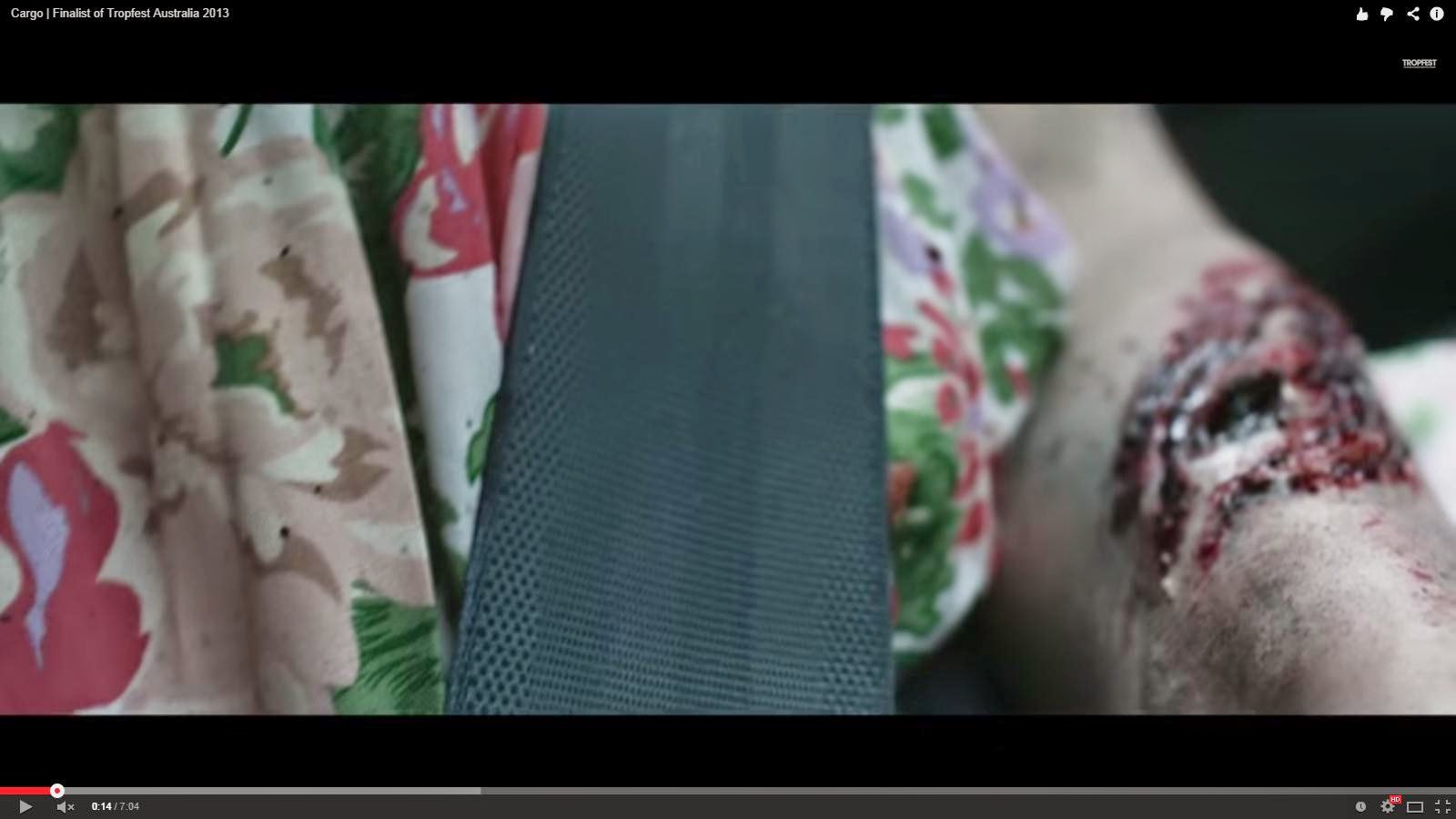


The use of shallow depth of field with the use of the mise-en-scene reflects the Genre, horror and the sub-genre zombie horror, of  the short film with the use of make up to create a bite on the arm which is shown out of focus in the shot, this also reflects the Narrative, in the opening 14 seconds of Cargo the narrative and genre are reflected. The mise-en-scene is used to reflect the age of the character through the use of the costume choice, as the costume being worn would be usually warn by someone more mature and less likely to be a young person, but also it reflects the gender of the unknown person, as costume designers will follow the codes and conventions of what each gender should wear.


Fast cuts are used with the help of the mise-en-scene to re-enforce the narrative of the short film cargo. This frame is used to prompt the audience to what has happened through the use of the mise-en-scene, as in the shot above there is the use of the seat belt and this there is a broken windscreen and blood, which adds to the narrative of car accident within a zombie apocalypse, The audience piece together the fact that this has happened through the use of the mise-en-scene in the frame above with the use of shallow depth of field.


Soft focus is used again in a media close up. This is done to foreshadow the action of what is to come in the next scene. The soft focus is used to make the audience feel disorientated and to represent the characters disorientation.


The use of the mise-en-scene reflects narrative and genre. The medium close up is used to show the make-up used to create the effect of the female looking like a zombie reinforcing both the genre, sub-genre and narrative.


Cargo is heavily reliant on mise-en-scene like most horror films, as the mise-en-scene is used to reinforce both the Genre/sub-genre and narrative of the media product. The props within the media product are used well, in the way of telling the audience parts of the narrative that aren't needed, for instance the crashed car outlines that there has been some sort of car crash without having to show that the audience know this. The use of costume is basic but works to outline the ages of the character, without having to explain or inform the audience of the ages.  Sound is not relied on within Cargo to make it a successful media product, no dialogue is used within the product only diegetic sounds such as, a baby crying and zombie groans. This is really effective because without the dialogue the narrative is still very clear, non-diegetic music is played throughout the film, the pace of the music changes depending on the pace of the action within the frame showed.  A hand held camera is used throughout to create the effect of uneasiness and struggle of the protagonist is feeling throughout the action we are seeing. This is cleverly done to create a feeling of uneasiness for both the audience and the protagonist. Editing is not predominantly used within Cargo, it is basic and minimal editing which doesn’t affect the media product in a bad way it, it just is easier to watch as the action is in longer shots meaning it is less confusing for the audience.

Cargo was directed by:Ben Howling and Yolanda Ramke

Written by:
Yolanda Ramke

Produced by:

  • Daniel Foeldes (Done the cinematography of five other short films but only directed Cargo)
  • Marcus Newman (Assistant/director for four other short films, editor for the Lego Movie, and
    directed/produced one other short film)
  • Yolanda Ramke (produced one other short film and acted in three)
  • Ben Howling (produced/directed/written/ did the cinematography of two other short films)

In 2013, it was part of the Tropfest film festival finalists for short films. They worked with Dreaming Tree Productions, this is the first film that Dreaming Tree Productions have filmed. Cargo was nominated for one award for Best Editing in a short film but did not win. All of the production crew for Cargo have all had experience within the film industry meaning that each of them has skills which have contributed to the making of this film.


Thursday, 18 September 2014

Genre - Setting

Horror films are conventionally set in abandoned places such as abandoned mental hospitals, dark alley ways, asylums, cabins in the woods, usually rural small cities, graveyards, old houses, it is very unseen that the main action happens in Big cities such as London or New York, (this usually happens in Zombie films to give a feel or realism). Set directors do this to create the feeling of isolation and danger for the protagonist character.


This would be a conventional setting for a horror film because:

  • Hardly any light is coming in - meaning it is dark, gloomy and scary
  • Danger is shown in the fact of it being abandoned which lets the audience percieve and stereotype the possibility of haunting
  • There is things that could be used to cause injury and pain to the pro/antagonist.
  • There is one door which looks as if to be blocked by wood ect.
  • The only beam of light coming in is high up meaning there is no possibility of the antagonist escaping that way meaning there is one exit which is usually blocked by something.


This would be a conventional setting for a horror film because:

  • It is creepy
  • It causes the audience to ponder the possibilities of what used to be there
  • It is conventional of horror films
  • The props i.e the trolley shown in the middle can be used and played with to scare the audience.


This would be a conventional setting for a horror film because:

     
  • The mise-en-scene of the overgrown shrubary gives the house a creepy look
  • The audience will assume because it's old, conventionally it will be haunted.
  • The dark lighting gives it a creepy effect.
  • The iron gates make the audience feel trapped.


Wednesday, 17 September 2014

My film.


My short film synopsis –

The Virus.

My Narrative.

My narrative type(s) are:

Achillies, Circe and Orpheous.


Genre

Genre - the term or category of forms of entertainment which are based on some set stylistic criteria 


My film genre:

Horror


Horror - 

My film will be horror because the conventions of the genre are

  • Setting
  • Technical Codes
  • Iconography
  • Narrative Structure 
  • Character types 
  • Themes